As presented at ARC Industry Forum and ICC 2026 · Speaking at CODESYS Tech Talk

+1 (888) 316-6978 or Sales@Surety-Automation.com

  • Sign In
  • Create Account

  • Orders
  • My Account
  • Signed in as:

  • filler@godaddy.com


  • Orders
  • My Account
  • Sign out

  • Home
  • Contact Us
  • Integration
    • How We Build
    • Services
    • Design
    • Mining Solutions
    • Block Light Visualization
  • Products
    • Shop
    • Work Safety Apps
    • Instrument RFQ App
    • Maestro Digital Mine
    • DuraPinch Products
    • Ultimo Densitometers
    • PS Automation - Actuators
  • More
    • Home
    • Contact Us
    • Integration
      • How We Build
      • Services
      • Design
      • Mining Solutions
      • Block Light Visualization
    • Products
      • Shop
      • Work Safety Apps
      • Instrument RFQ App
      • Maestro Digital Mine
      • DuraPinch Products
      • Ultimo Densitometers
      • PS Automation - Actuators

+1 (888) 316-6978 or Sales@Surety-Automation.com

Signed in as:

filler@godaddy.com

  • Home
  • Contact Us
  • Integration
    • How We Build
    • Services
    • Design
    • Mining Solutions
    • Block Light Visualization
  • Products
    • Shop
    • Work Safety Apps
    • Instrument RFQ App
    • Maestro Digital Mine
    • DuraPinch Products
    • Ultimo Densitometers
    • PS Automation - Actuators

Account


  • Orders
  • My Account
  • Sign out


  • Sign In
  • Orders
  • My Account

How We Build

One source of truth, from the field device to the boardroom.

We design control systems so that every value has one origin, one path, and one owner — measured once at the edge, secured at the boundary, and delivered everywhere it is needed without being copied, re-typed, or guessed at. It is how the best plants will run in ten years. We build it today. 

Most field automation fails the same four ways.

Trapped data.

Oversized panels.

Oversized panels.

The value exists, but it lives in a proprietary driver, a rack no one can touch, or a spreadsheet someone re-types on Friday. By the time it reaches a decision it is a copy of a copy. 

Oversized panels.

Oversized panels.

Oversized panels.

The reflex fix for "no visibility" is to add: a bigger PLC, more I/O cards, another cabinet, another server. More hardware, more wiring, more to power, cool, and maintain — and no more information. 

Fragile networks.

Security bolted on late.

Security bolted on late.

 Fiber gets cut. Radios fade. Cellular drops. A design that assumes the link is up will lose data, or worse, lose control, exactly when it matters. 

Security bolted on late.

Security bolted on late.

Security bolted on late.

 Certificates on every field device, renewals nobody tracks, and a VPN that was meant to be temporary. Security that depends on a technician remembering something is not security. 

Isn't this model just a dcs?

No, and here's why.

A DCS gets you one source of truth by owning everything: controllers, I/O, historian, HMI and engineering tools from a single vendor, sitting in a single plant. It works when your process is in one building.


Most of ours isn't. A pump station an hour underground, a batch plant with three silos, dozens of stations spread across a state. A DCS answers that with a remote I/O drop over a network it assumes is always up, or a separate telemetry system, which puts you right back to two sources of truth.


We get the same data integrity a different way: open standards at every layer, intelligence at the edge so a station keeps running and keeps its history when the link is down, and hardware your own people can buy, replace and maintain. That is also why it costs a fraction of a DCS to license and to keep, but the price is a consequence of the design, not the reason for it.

The data-integrity model

Every measurement in a Surety system is taken once, at the device, in its native digital form. Smart transmitters, digitally enabled starters, and IO-Link sensors already carry the process value, device health, diagnostics, and configuration. We do not convert that to 4–20 mA and throw the rest away. We listen.


An edge controller at each station owns that data. It runs the control logic locally, keeps a local history, and publishes upward only what changed — report by exception — so a 48-site network moves a fraction of the traffic a polled system would, and a single-station outage stays a single-station problem.


When the network goes down, and in the field it goes down, the controller keeps running and keeps recording. When the link returns, it forwards what it stored, in order, with timestamps. The site historian never sees a gap. Nobody drives out to reconstruct a shift.


Above the edge, the data moves on open standards — OPC UA and MQTT Sparkplug B — into a single namespace that SCADA, the historian, maintenance, and the enterprise all read from. One name for every tag. One value. One place to fix it if it is wrong. 


"Less hardware, more data. That is not a trade-off; it is what happens when you stop converting digital devices to analog and back." 
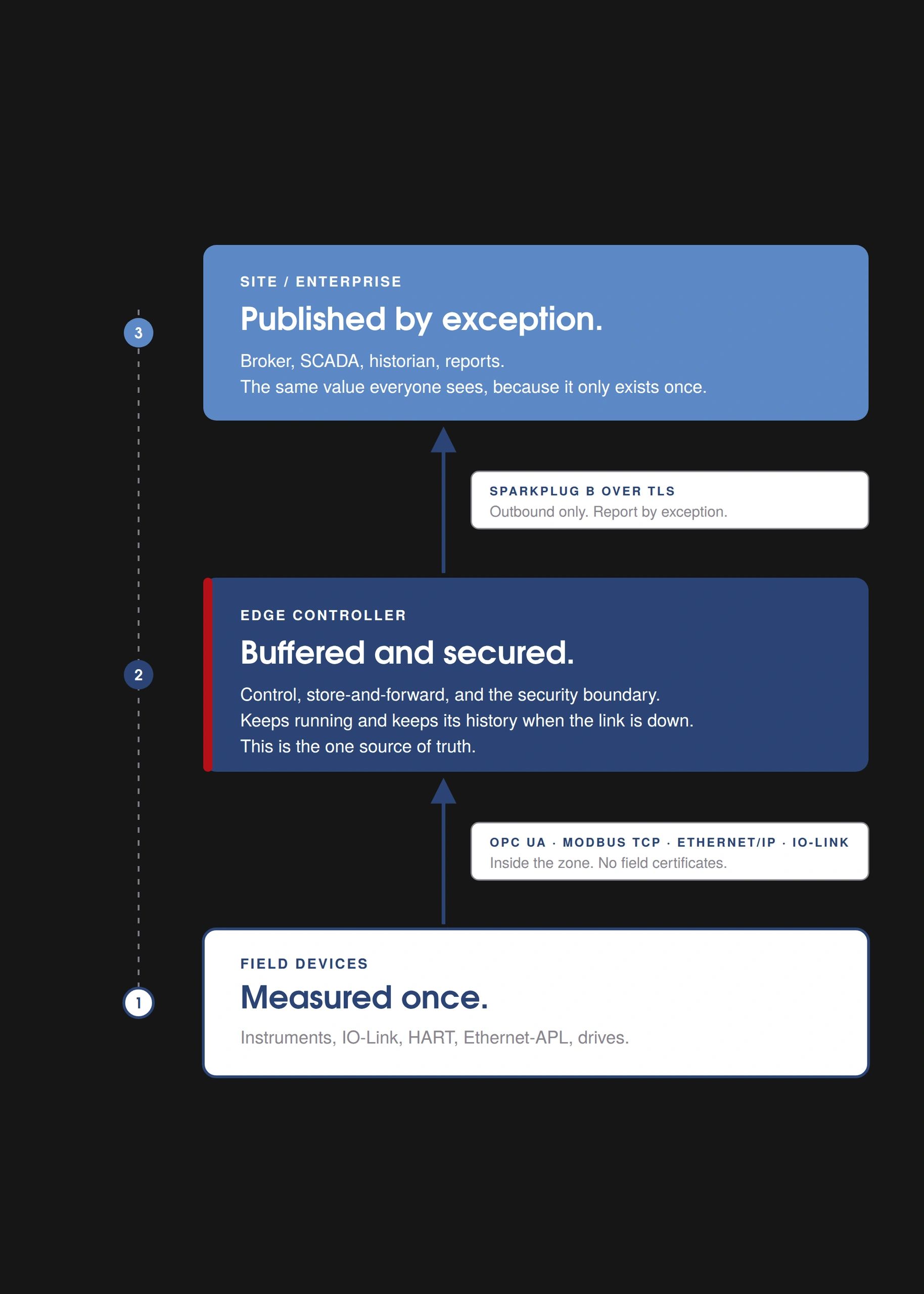
Four rules we build by

1. Do more with less.

One small panel per station: an edge controller with built-in I/O and networking, smart devices, and a gateway where the devices need one. No rack, no marshalling cabinet, no processor sized for a plant when the job is a sump. In our underground dewatering work this cut hardware and wiring cost per station by roughly a third and made every additional station a copy-and-configure job instead of a design job. 

2. Stay standard.

OPC UA, MQTT Sparkplug B, Modbus TCP, IO-Link, IEC 61131-3 code. Every layer in the drawing is replaceable, which is why the same design has moved from a gold mine to a cement batch plant to a gas transmission network without starting over. Integrated and open are not opposites. 

3. Design for those inevitable network failures.

Control lives at the edge and does not need the link. History lives at the edge and does not need the link. The link carries changes, not polls, and when it comes back the edge catches the site up. We test this by pulling the cable during commissioning, not by hoping. 

4. Secure the zone, not the device.

Field instruments should not need certificate renewals. We put the security boundary where it can be maintained — at the panel and at the site edge — and make the physical enclosure part of the design. The next section shows how. 

Security you can maintain from a mile away

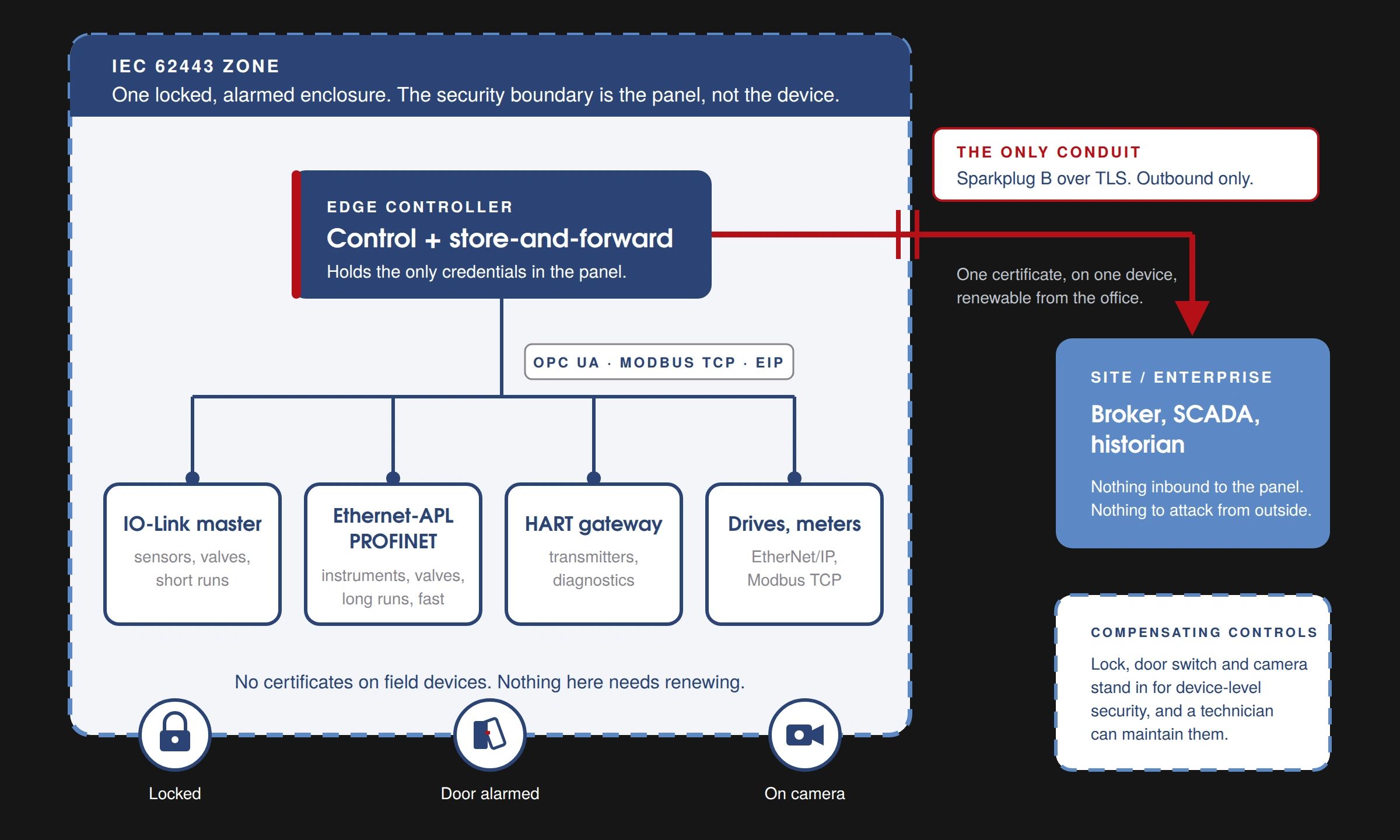
  • The locked, alarmed enclosure is the security zone. Inside it, devices talk OPC UA to the controller without certificates, because nothing outside the enclosure can reach them. That is what IEC 62443 calls a zone, and the door is its perimeter.
  • The only way out is one conduit: MQTT Sparkplug B over TLS, outbound only, from the edge controller to an on-premise broker inside the OT network. One endpoint to secure. One certificate to manage, on a device that is on the network and can be updated remotely.
  • The compensating controls are physical and they are on the drawing: gate, cameras, multiple locks, a door switch that alarms to SCADA. Open the panel and the operator knows before you have the cover off.
  • This is how a field system stays secure for ten years without a technician driving to every site to renew a certificate that expired on a Tuesday. It is also how IT gets what it needs — one TLS endpoint, one-way replication across the firewall, a data diode where the site warrants it — without reaching into the process.
  • This is the pattern we designed for a gas transmission network for a major utility, and we build every field panel to the same pattern whether it has one station or fifty. 


The same pattern, three industries

Mine dewatering architecture image.

Underground dewatering, at a gold mine


Miles of underground pump stations on one small control panel each: groov RIO running CODESYS, smart transmitters through a HART gateway, Ignition Edge for local HMI and history, store-and-forward to site SCADA.


Drives and starters get their own enclosure. The control panel stays small, cool, and quiet.


 Case study: From smart sumps to smarter mines → 

IO-Link architecture image.

IO-Link batch plant


Silo levels, valves, pushbuttons, and a signal tower on IO-Link, served as native OPC UA straight to the controller. No translation layer. Safety hardwired and off-network. Eleven spare ports for expansion without redesign.

Talk to us about IO-Link →

Dozens of stations, one namespace


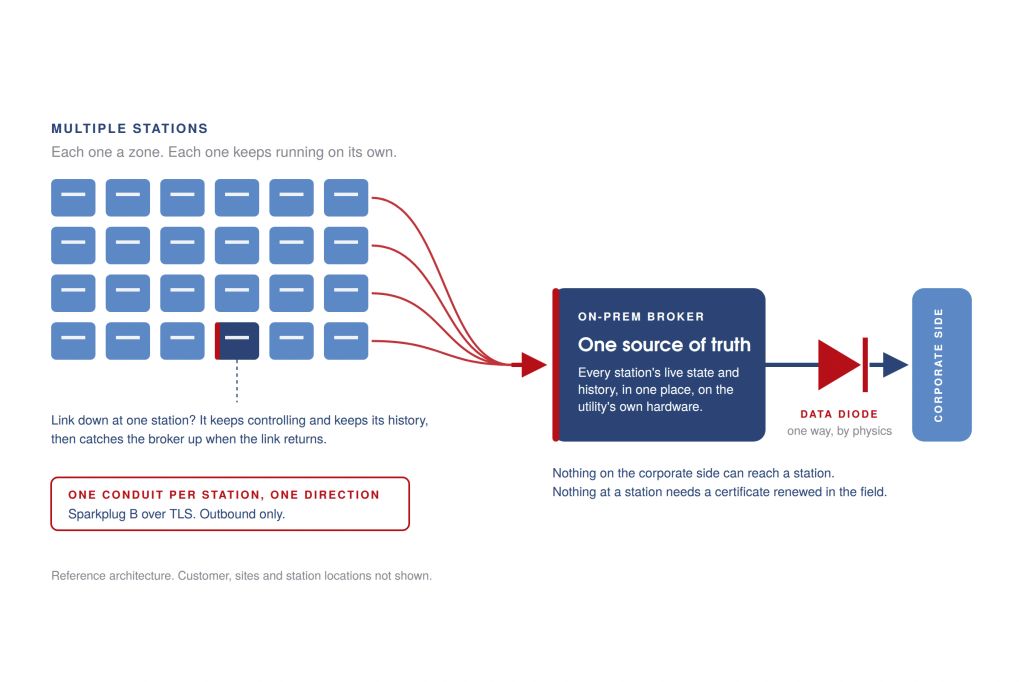
Edge nodes at every station publishing by exception over Sparkplug B to an on-premise broker. Three infrastructure decisions made before the first node shipped: where the broker lives, how the master server is sized, and where the boundary sits.


Talk to us about remote SCADA →

Built on partners we would choose again
Opto 22

Inductive Automation

Inductive Automation

groov RIO and groov EPIC edge controllers. CODESYS runtime, Ignition Edge on board, open protocols out of the box. Surety is an IIoT-Certified OptoPartner.
Visit Opto 22

Inductive Automation

Inductive Automation

Inductive Automation

Ignition, Ignition Edge, and Ignition Edge Panel for HMI, history, and the single namespace above the edge. Surety is a registered Ignition integrator.
Visit Inductive Automation

Phoenix Contact

Phoenix Contact

Phoenix Contact

Every Surety panel is built on Phoenix Contact power, terminals, and switching. One vendor, one support path, and a bay-sized panel that fits.

Visit Phoenix Contact USA

Codesys

Phoenix Contact

Phoenix Contact

IEC 61131-3 control logic, written in structured text and function blocks, portable across the edge hardware we use. 

Visit Codesys USA

Have a system that needs one source of truth?

Tell us what you are measuring, where it is, and who needs to see it. We will tell you what we would build and what it would cost to find out. 

Talk to us

Copyright © 2026 Surety Automation - All Rights Reserved.

Powered by

  • Privacy Policy
  • Terms and Conditions
  • Contact Us
  • Maestro Digital Mine
  • DuraPinch Products
  • Ultimo Densitometers
  • PS Automation - Actuators

This website uses cookies.

We use cookies to analyze website traffic and optimize your website experience. By accepting our use of cookies, your data will be aggregated with all other user data.

DeclineAccept